
We will accept you as a Jew, if...
A Sentence That Feels Like a Diagnosis

A sentence often attributed online to Golda Meir has been making the rounds again: “Israel exists not because the world wanted it to, but because Jews decided they would no longer wait for the world’s permission.” Whether or not Meir said those exact words, the sentiment captures something many Jews have felt deeply since October 7, 2023: the world is often willing to accept Jews, but only under certain conditions.
The Checklist of Acceptability
On Instagram, London-based chef Josh Halmer, @falmer.uk, touched on this new reality of diaspora Jewish life in a recent post. He described the checklist that seems to be handed to Jews who want to remain socially acceptable: diaspora rather than Zionist, cultural rather than religious, Holocaust-remembering rather than Israel-defending, grieving rather than fighting back.
I myself have fallen into this trap. In London, I attended a Reform synagogue regularly, but I often found myself explaining to non-Jews that it was “more of a cultural” affair. That explanation was not entirely false, but it was also not entirely honest. It was a way of softening Jewishness into something more acceptable, something less demanding, something that did not require anyone else to confront the religious, national, historical, and ancestral dimensions of Jewish identity.
That checklist hurts because it is recognizable. It reflects the difference between the Jew the world is comfortable mourning and the Jew the world becomes uneasy seeing alive, organized, sovereign, proud, and unwilling to disappear.
The Comfort of Dead Jews
This tension also sits at the heart of Dara Horn’s book, People Love Dead Jews. As discussed in this Times of Israel blog post, Horn argues that Jewish suffering is often easier for the world to process than Jewish survival.
A murdered Jew can be universalized and turned into a lesson about tolerance, prejudice, and moral failure. A living Jew, however, asks for protection, expresses opinions, maintains ties to land and peoplehood, and insists on the right to say no.
That is where the discomfort begins.
Conditional Acceptance in Practice
The acceptable Jew is expected to remember the Holocaust, but not to apply its lessons too forcefully. The acceptable Jew can light a memorial candle, but should hesitate before asserting that Jewish people need the power to defend themselves. The acceptable Jew can celebrate culture, share traditions, and educate others about antisemitism in abstract terms.
Yet the moment that same Jew says, “Israel has a right to exist,” the atmosphere shifts. Acceptance becomes conditional.
“The moment you support Israel’s right to exist, you are no longer welcome.”
Josh Halmer, @falmer.uk
For many young Jews on the left, this realization has been deeply painful. Since before college, I was an active participant in many causes. I often voted for the Green Party, supported Greta Thunberg’s climate action, fought for same-sex marriage in the 2000s, attended most of London’s Black Lives Matter marches in 2020, read and debated books like Americanah, We Should All Be Feminists, Why I Am No Longer Talking to White People About Race, Black, Listed, and White Fragility, and stood with the trans community when their rights were being dialed back.
None of this seems to count now. To many past friends, I am on the wrong side of history because I support Israel’s right to exist. Decades of friendships have been thrown out over accusations of “genocide” or whatever buzzword they learned from TikTok to make themselves feel part of a greater cause.
The Loyalty Test
It was not a test of whether Jews could criticize an Israeli government, which Jews do regularly. It was not a test of whether Jews could feel compassion for Palestinian civilians, which many do. The test was more fundamental: whether they could affirm that the Jewish people are entitled to self-determination, safety, and survival.
In too many social circles, universities, activist spaces, and cultural institutions, the answer turned out to be conditional.
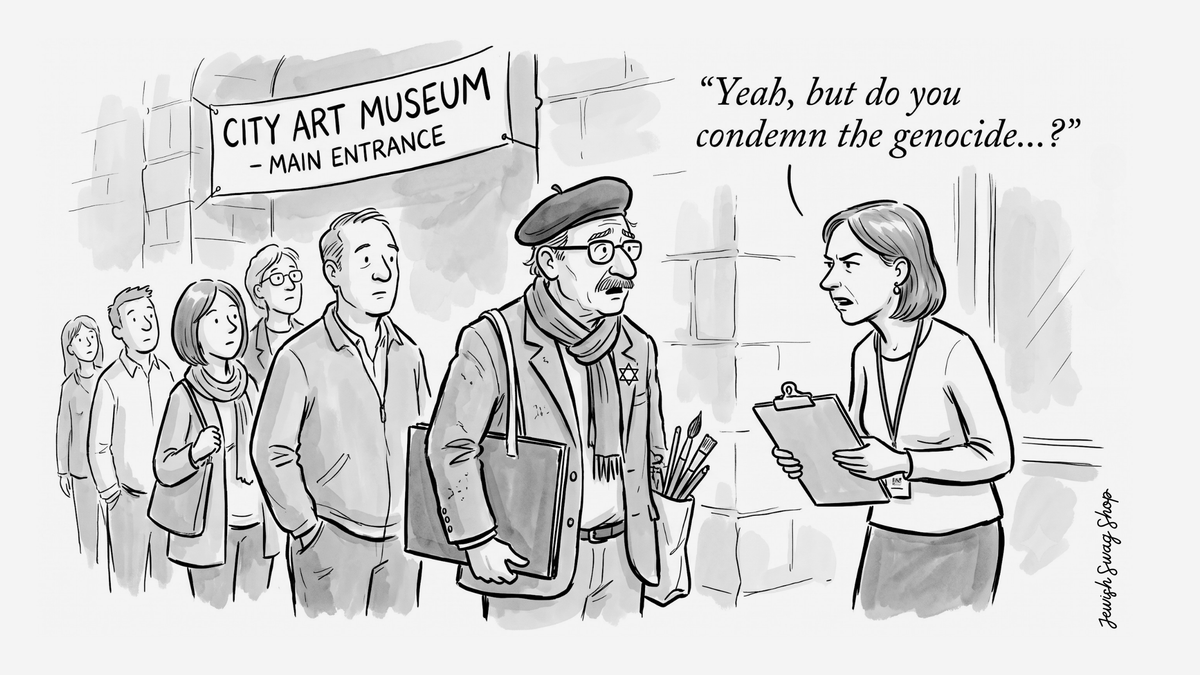
We will accept you as a Jew if you denounce Israel. We will platform you if you distance yourself from “those” Jews. We will acknowledge antisemitism, but only if you also acknowledge the supposed injustice perpetrated by your kind. We will invite Jewish artists if they clarify their political positions. We will oppose hate, but only when it is generalized. We will listen to your Jewish fear as long as it does not disrupt our comfort.
Collective Suspicion in Cultural Spaces
This dynamic became especially visible in the arts world after October 7, where Jewish creatives often found themselves subject to political scrutiny that others did not face. Russian artists were not routinely asked to answer for Vladimir Putin, nor were Chinese artists required to clarify their stance on the Uyghurs or Tibet. Muslim artists were not expected to account for every Islamist regime or extremist group before being treated as individuals.
Yet Jews were repeatedly asked to explain Israel.
Not Israeli officials or policymakers, but Jews as individuals: dancers, writers, comedians, students, professors, actors, artists, and performers. Jewish artists with no direct role in shaping Israeli policy are expected to justify or distance themselves from the Jewish homeland. Worse, many Jewish artists describe simply being disinvited or not being booked anymore.
This pattern reflects something deeper than ordinary political accountability. It reflects collective suspicion, regardless of individual politics. As the joke goes: a Zionist Jew and an anti-Zionist Jew walk into a bar, and the bartender says, “Sorry, we do not serve Jews.”

A Historical Pattern of Conditional Belonging
Falmer places this within a longer historical pattern: “Medieval Europe: Convert and we’ll tolerate you. Enlightenment: Assimilate and we’ll accept you. 20th century: Disappear quietly. Today: Denounce Israel and we’ll platform you.” The language has changed, but the underlying structure remains familiar. The demand shifts, yet the bargain stays the same: reduce yourself, and you may be allowed to remain.
Jews recognize this pattern instinctively. There has always been a version of Jewish identity that surrounding societies preferred. At different times, it has been the converted Jew, the assimilated Jew, the quiet Jew, or the grateful Jew. Today, in certain elite spaces, it is the anti-Zionist Jew who can be presented as evidence that the institution is not antisemitic.
After all, they invited a Jew.

The Problem with the “Good Jew”
But the question remains: what kind of Jew did they invite? Did they invite someone who could speak freely, or someone whose identity had already been filtered? Did they invite a full person, or only the aspects that felt comfortable to the audience?
This is what makes the idea of the “good Jew” so unstable. The criteria keep shifting. At first, the expectation may be to criticize Israeli policy. Then it becomes a demand to reject Zionism altogether. Over time, the expectations expand: avoid certain events, conceal visible symbols, refrain from mentioning specific topics, and soften expressions of grief.
Each concession leads to another.
The Acceptable Jew in Contemporary Discourse
Dori Zuravicky Bomback explores this dynamic in her Jewish Ledger op-ed, “The Acceptable Jew.” She describes a social bargain in which Jewish identity is tolerated only when it is separated from Zionism. Her argument does not deny the legitimacy of criticizing Israeli policy. Rather, it highlights how Jewish peoplehood itself is increasingly treated as negotiable.
That is the line many Jews are being asked to cross.
The expectation is not simply to engage in political debate, but to distance oneself from Jewish sovereignty, from the idea of Jews as a people, and from the existence of a Jewish state. Only then, it is implied, can one be considered acceptable.
Polite Language, Persistent Pressure
This dynamic functions less as solidarity and more as a loyalty test. It is particularly painful when it comes from communities that Jews once considered allies. Falmer captures this when he writes, “It doesn’t come as a slur. It comes as a concern.” Modern antisemitism often appears in polite language, framed as curiosity or moral inquiry. It may sound like a colleague asking where you stand, an administrator urging balance, or a friend prefacing concern with a political statement.
It arrives wrapped in moral vocabulary.
Those expressing it often insist that they do not dislike Jews. They claim to oppose Zionism, nationalism, or power structures. Yet their critiques repeatedly converge on the same small group, accompanied by a familiar demand: adjust your identity in ways that make us more comfortable.
Reclaiming “Just Jewish”
In this context, the phrase “just Jewish” has taken on new significance. It represents a refusal to qualify or dilute identity for the sake of acceptance. It describes a Jew who embraces memory, peoplehood, and connection to Israel without apology, while still engaging critically and compassionately with the world.
Such a stance reflects dignity and self-respect.
Lessons from History and the Case for Sovereignty
There is a reason Israel exists. It emerged from a long history in which Jews learned that conditional acceptance does not guarantee safety. Conversion, assimilation, silence, and respectability all failed to provide lasting protection. Again and again, Jews discovered that acceptance could be withdrawn at any moment.
In response, Jewish communities invested in continuity and resilience. They built families, schools, synagogues, and cultural institutions. They revived languages, established communities, and created systems of mutual support. They also built a state.
This aspect of Jewish survival can provoke discomfort. Many people find it easier to engage with Jewish history as a story of victimhood than as a story of agency and self-determination.
Living Openly in an Uncertain World
Falmer also writes about the fear many Jews feel today: concerns about visibility, safety, and belonging in places that once felt secure. These fears are not abstract. They reflect real experiences in contemporary societies.
At the same time, history suggests that attempts to minimize or conceal Jewish identity have never provided reliable protection. Efforts to blend in or remain silent have not prevented exclusion or violence. Given that both visibility and invisibility carry risks, many Jews conclude that living openly offers a more honest path.
Refusing the Bargain
The challenge, then, is not simply survival but self-definition. Jewish history includes persecution, but it also includes return, memory, creativity, and continuity. It reflects an ongoing refusal to allow others to dictate the boundaries of Jewish identity.
For that reason, many Jews reject the idea that they must audition for acceptance. They do not see a need to submit statements, disclaimers, or political credentials in order to belong. They resist the expectation that identity must be reshaped to fit external preferences.
Instead, they embrace the complexity of being Jewish in multiple dimensions at once: cultural and religious, diasporic and connected to Israel, capable of grief and self-defense, critical and committed.
The world may continue to offer variations of the same bargain, suggesting that acceptance depends on self-limitation. Yet history has shown that such bargains rarely hold.
Many Jews have therefore stopped waiting for permission. They choose to live openly as Jews, without disclaimers or apologies.
Just Jewish. No disclaimer. No apology.
Frequently Asked Questions
What does “conditional acceptance” mean in this context?
Conditional acceptance refers to the idea that Jews are accepted socially or culturally only if they meet certain expectations, such as distancing themselves from Israel, rejecting Zionism, or limiting visible expressions of Jewish identity.
What is meant by the “acceptable Jew”?
The “acceptable Jew” is a concept describing a version of Jewish identity that aligns with external expectations. In many contemporary spaces, this often means a Jew who is welcome only if they publicly distances themselves from Israel or Jewish peoplehood.
How does Dara Horn’s People Love Dead Jews relate to this discussion?
Dara Horn’s book argues that society often finds it easier to engage with Jewish suffering than with Jewish survival. This article applies that idea to the way living Jews are often asked to soften, explain, or qualify their identity when they assert agency, peoplehood, or self-defense.
Why are Jews often asked to explain Israel in public spaces?
This reflects a pattern of collective responsibility being placed on Jews as individuals, even when they have no direct role in Israeli policy. The same expectation is not consistently applied to members of other national, ethnic, or religious groups.
Is criticism of Israel inherently antisemitic?
No. Criticism of Israeli policies is a normal part of political discourse, and Israelis themselves engage in it constantly. The issue arises when criticism of Israel becomes a condition for accepting Jewish identity, when Jews are treated collectively as responsible for Israel, or when the Jewish right to self-determination is denied altogether.
What historical patterns are referenced in the article?
The article references recurring demands placed on Jews throughout history, including conversion, assimilation, silence, and political self-erasure as conditions for acceptance.
What does “just Jewish” signify today?
“Just Jewish” represents an unapologetic embrace of Jewish identity in all its dimensions, including culture, religion, peoplehood, history, and connection to Israel. It rejects the need to qualify or dilute Jewishness for external approval.
What practical steps can individuals take in response to these dynamics?
Individuals can educate themselves about Jewish history, challenge double standards, support inclusive environments, and respect Jewish identity without imposing political conditions on Jewish belonging.
Sources and Further Reading
Sources Mentioned
- Dara Horn, People Love Dead Jews
- Times of Israel Blog: “People Love Dead Jews”
- Dori Zuravicky Bomback, “The Acceptable Jew,” Jewish Ledger
- Josh Halmer, Instagram post by @falmer.uk
- Josh Halmer, Instagram post on Jewish visibility and refusal to shrink
Further Reading
- Deborah Lipstadt, Antisemitism: Here and Now
- Bari Weiss, How to Fight Anti-Semitism
- David Nirenberg, Anti-Judaism: The Western Tradition
- Jeffrey Kass, “Zohran Mamdani and Hasidic Jews: A Token-Based Alliance Built on Rejection of Israel”