
What Is Purim? A Complete, Historically Grounded, Culturally Rich Guide to Judaism's Most Misunderstood Holiday
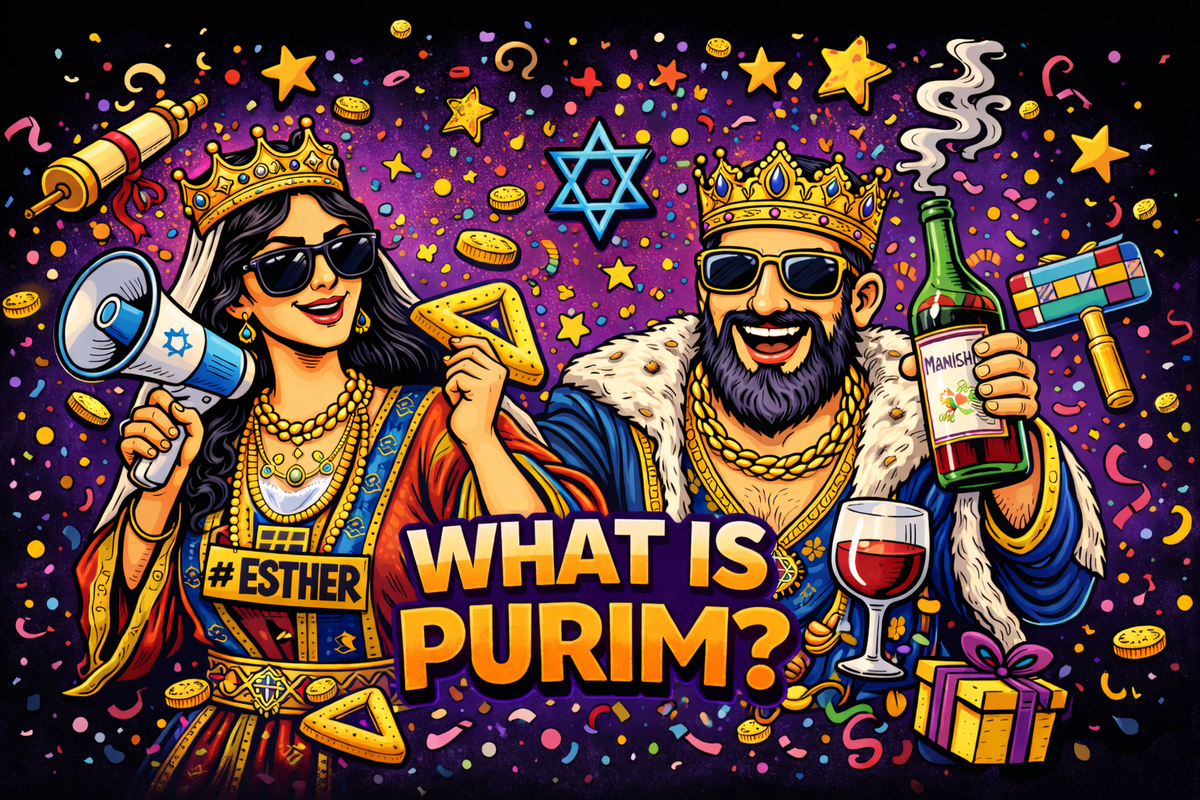
The Most Festive Holiday You've Never Understood
Picture this: it is a Tuesday night in March, and a man in a full Darth Vader costume is walking into a synagogue carrying a noisemaker the size of a medieval flail. Inside, a rabbi in a sequined cowboy hat is about to read from an ancient scroll, and every time he says one particular name, the entire congregation erupts in a synchronized, cacophonous roar of rattles, stomps, and righteous booing. A seven-year-old dressed as Queen Elsa hands you a gift basket containing hamantaschen, a bottle of wine, and what appears to be an artisan salami. Someone's grandfather is, by religious mandate, working on his third drink.
This is Purim, and it is entirely serious about not being serious.
Purim (pronounced POO-rim, Hebrew for "lots," as in a lottery or random drawing) is the Jewish holiday commemorating the salvation of the Jewish people from a genocidal plot in the ancient Persian Empire, as recounted in the biblical Book of Esther, known in Hebrew as the Megillah. Observed annually on the 14th of the Hebrew month of Adar (typically falling in February or March), Purim is marked by four central religious obligations: hearing the Megillah read aloud, giving gifts of food to friends, donating to the poor, and eating a festive meal. It is simultaneously one of the most joyous days in the Jewish calendar and one of the most theologically layered: a holiday about hidden Providence, political courage, and the fragility of Jewish security, dressed up as a costume party.
The Story: A Political Thriller Set in Persia
Before you can understand Purim, you need to meet its cast, and they are, by any standard, extraordinary.
The story opens in Shushan (Susa), the opulent capital of the Achaemenid Persian Empire, at the court of King Achashverosh (most commonly identified with Xerxes I, who reigned 486 to 465 BCE, though the identification remains contested among scholars). Achashverosh is the kind of king who throws a 180-day banquet to show off his wealth (not a typo) and whose decision-making is driven almost entirely by the counsel of whichever advisor happens to be standing nearest to him. He is powerful and impulsive, less a villain than a force of nature: an instrument through which worse men and better ones alike can act.
When his queen, Vashti, refuses to parade herself before his drunken guests — an act variously interpreted as courageous dignity, political insubordination, or both — Achashverosh banishes her and holds what amounts to an empire-wide beauty pageant for a new queen. If you find yourself sympathizing with Vashti, you're not alone: she's got a whole fan club, and we sell the shirt. Justice for Vashti — Setting Boundaries Since 356 BCE.
This is where Esther enters. A young Jewish woman of striking beauty and considerable intelligence, Esther is an orphan raised by her older cousin Mordechai, a respected figure at the palace gate. On Mordechai's counsel, Esther conceals her Jewish identity as she wins the king's favor and becomes queen. The concealment is not cowardice; it is strategy, or perhaps the story's way of signaling that Jewish survival in diaspora has always required navigating visibility and invisibility with precision.
Enter Haman, the story's antagonist and, in Jewish tradition, shorthand for existential threat. A high minister of the empire, Haman nurses a spectacular ego that cannot survive the one affront he cannot control: Mordechai refuses to bow to him. Why Mordechai refuses is debated — pride, Benjaminite tribal history, theological objection — but the refusal ignites something catastrophic in Haman. Rather than addressing one man's insubordination, Haman decides to destroy all the Jews of the empire. He consults lots (purim, that word again) to select the optimal date for the massacre, secures a decree from Achashverosh through bureaucratic manipulation, and begins his preparations. The man deserves every boo he gets — and we've got the gear for that: the BOOO Haman Megillah Night Tee and the BOOO Haman Long Sleeve say it clearly.
The decree sends Mordechai into mourning and Esther into crisis. In the most pivotal exchange of the story, Mordechai sends Esther a message that functions as both challenge and prophecy: "Who knows whether it was for just such a moment that you attained royal position?" This is not flattery. It is an ultimatum wrapped in a theological question — the Megillah's suggestion that historical contingency and divine purpose may be the same thing.
"Who knows whether it was for just such a moment that you attained royal position?" — Mordechai to Esther, Megillat Esther 4:14
Esther's response is to fast for three days, gather her courage, and approach the king uninvited (a potentially capital offense) to invite him and Haman to a dinner. The psychological gamesmanship of what follows is extraordinary. Esther does not immediately expose Haman. She lets tension and proximity do their work, inviting both men to a second dinner before finally revealing, at the perfectly calibrated moment, that she is Jewish, and that the man sitting across the table is planning to kill her people.
Achashverosh, who appears to have had no idea this was about his wife's people, leaves the room in fury. Haman throws himself at Esther's feet to beg, and the king walks back in to find him apparently assaulting the queen. It is, even by modern dramatic standards, a masterclass in timing. Haman is hanged on the very gallows he built for Mordechai. A counter-decree is issued. The Jews of Persia fight back against their attackers and survive. Mordechai and Esther institutionalize the annual celebration as a permanent commemoration for all generations.
Haman's wife, Zeresh, appears only briefly but memorably. She advises him to build the gallows for Mordechai and, after the tables turn, is the first to tell her husband that if Mordechai is of Jewish descent, Haman has already lost. There is something almost Shakespearean in the way Zeresh's counsel, meant to accelerate destruction, functions as foreshadowing of her husband's doom.
The Four Mitzvot: A Theology of Obligation
Jewish holidays tend to be structured around mitzvot (commandments or obligations) that translate abstract theological meaning into concrete action. Purim has four, and understanding them reveals the holiday's moral architecture.
The first is Mikra Megillah, the public reading of the Book of Esther, twice: once at night and once during the day. This is not merely storytelling. The obligation to hear the Megillah is legally precise; individual words matter. The congregation's raucous noise-making whenever Haman's name is spoken (the famous gragger or ra'ashan) is not interruption but participation: a ritualized refusal to let evil pass in silence. If you want to arrive dressed for the occasion, The Full Megillah tee covers it — literally.
The second mitzvah is Mishloach Manot, literally "sending portions." Each person is obligated to send at least two ready-to-eat food items to at least one friend. The tradition is simultaneously communal glue and a small lesson in abundance: you give when you have enough to give. In practice, Mishloach Manot baskets have become elaborate productions (themed, curated, sometimes competitive) but the halakhic minimum remains modest: two foods, one recipient.
The third is Matanot L'evyonim, gifts to the poor. On Purim day, each person must give monetary gifts to at least two poor people. The rabbis are explicit that this mitzvah should not be deprioritized in favor of feasting; concern for those who cannot celebrate is built into the celebration itself. Many authorities hold that money given for Matanot L'evyonim should be distributed on Purim day rather than pledged in advance, preserving its immediacy and its dignity.
The fourth is Seudah, a festive meal, typically held in the afternoon of Purim day. Wine is central to the seudah, and here Judaism does something genuinely surprising: the Talmud records an opinion that one should drink on Purim until they cannot distinguish between "Blessed is Mordechai" and "Cursed is Haman" (ad delo yada, in Aramaic).[1] Rabbinic authorities have spent centuries debating the precise contours of this instruction; the range of interpretations runs from literal intoxication to a single extra cup to a nap. What no one debates is the intention: on Purim, the normal orderings of the world are meant to feel, briefly, inverted. The hidden becomes revealed. The condemned becomes the victor. The drunk and the wise arrive, mysteriously, at the same truth. The Haman & Mordechai "Ad Delo Yada" Hoodie commemorates this particular rabbinic instruction with appropriate gravitas.
History and Scholarship: How Real Is the Story?
The question of Purim's historicity is one scholars approach with more nuance than popular discourse usually allows. The Book of Esther is the only book of the Hebrew Bible in which God is never explicitly mentioned, a fact that has fueled centuries of theological interpretation and contributed to its disputed inclusion in the canon.[2] It reads, in places, with the interiority and irony of literary fiction. And yet its Persian court details are, by the standards of ancient literature, remarkably accurate.
The Achaemenid Persian Empire was the largest empire the ancient world had yet seen, and its administrative complexity, multicultural governance, and use of written royal decrees are well-documented in sources like the Persepolis Fortification Tablets.[3] The Megillah's descriptions of the palace at Susa, the court protocol, the irrevocability of royal edicts, and the empire's 127-province structure align with what archaeology and Persian administrative records confirm. This is not accidental.
The identification of Achashverosh with Xerxes I is the dominant scholarly position, based on linguistic parallels between "Achashverosh" and the Old Persian "Khshayarsha."[4] The name "Esther" has been tentatively linked to "Ishtar," the Babylonian goddess, and to the Persian "Stara" (star). Mordechai has been compared to "Marduka," a name that appears in Persepolis administrative tablets. None of these correspondences proves historical reality, but they suggest the story is anchored in a real cultural and bureaucratic world.
Scholarly opinion today ranges from reading the Megillah as deliberate historical fiction — a diaspora community's idealized narrative of survival — to viewing it as containing a genuine historical core that was elaborated over time. Carey Moore, a leading Esther scholar, characterizes it as a literary work of the highest order that reflects real Persian social conditions without functioning as a chronicle.[5] Jon Levenson's more theologically attentive reading foregrounds the book's sophistication as a document about concealment: of identity, of divine action, and of historical meaning.[6] What most serious scholars agree on is that the Purim story, regardless of its precise historicity, encodes real anxieties that were real to real Jewish communities: about security, about assimilation, about the moment when a minority population discovers that official tolerance is not the same as safety.
How Purim Is Celebrated Around the World
Purim is legally the same holiday everywhere, but its cultural expression is anything but uniform.
In Ashkenazi communities (Jews of Central and Eastern European descent), Purim is inseparable from hamantaschen, the triangular filled pastry whose name means "Haman's pockets" in Yiddish (though some scholars prefer the Hebrew oznei Haman, "Haman's ears"). Poppy seed and prune are the traditional fillings; chocolate and Nutella are the contemporary usurpers. The Purim shpiel — a satirical theatrical performance mocking communal figures, rabbis, and sometimes God — is an Ashkenazi institution that functions as institutionalized irreverence, a valve for a community that values deference.
Sephardic communities (Jews of Spanish and Portuguese origin and their descendants) often approach Purim with slightly more decorum but no less joy. In many Sephardic traditions, a "Purim king" is elected to preside over the festivities with mock authority. Sephardic communities in Israel, Turkey, Greece, and the Americas may read the Megillah to distinctive melodic traditions that differ substantially from Ashkenazi cantillation.
Moroccan Jewish communities observe a tradition called Mimouna after Passover, but their Purim celebrations are notable for the Purim de las Bombas, a holiday within a holiday commemorating a specific local salvation in Casablanca in 1943. The tradition of community-specific "Purims" is itself an ancient practice; Frankfurt, Cairo, and Hebron all had their own.[7] These local Purims underscore a theological point embedded in the Megillah's institutionalization of the holiday: salvation is always particular before it is universal, and communities remember what happened to them.
Persian Jews (Mizrahi communities from Iran) observe Purim with a particular intensity, given the story's literal setting in their ancestral homeland. Persian Jewish Purim celebrations often include elaborate home seudot with rice-based dishes, fresh herbs, and Persian sweets like nan-e berenji and sohan. The Megillah is read with a distinctive Persian cantillation, and the holiday carries an emotional weight that is not quite the same as anywhere else. The tombs of Esther and Mordechai in Hamadan, Iran, remain a site of pilgrimage to this day, though the Jewish community that once maintained them has dwindled to near nothing.[8]
In Israel, Purim is a national semi-carnival. Tel Aviv's Purim parties are legendary; the holiday effectively functions as the Israeli Mardi Gras. Schools close, children parade through the streets in costume, and the entire country briefly becomes a theater of inversions. Municipalities hold adloyadas — public parades named for the Talmudic instruction to drink until you cannot tell the difference — combining the atmosphere of a street festival with the organizational chaos you might expect from a holiday celebrating narrative improbability. If you're going, the Purim Doodles All-Over Tee or the Purim Doodles Muscle Tank will fit right in.
Shushan Purim: Jerusalem's Extra Day and the City That Waits
In virtually every community around the world, Purim falls on the 14th of Adar. But in Jerusalem, and in a small number of other ancient walled cities, the holiday is observed one day later, on the 15th. This day is called Shushan Purim, and its existence is not an anomaly or a rabbinic accommodation. It is written directly into the story.
The Book of Esther records that while Jews throughout the Persian Empire fought back against their attackers on the 13th of Adar and rested and celebrated on the 14th, the Jews of Shushan itself — a walled capital city — fought for two days and celebrated on the 15th. When the rabbis institutionalized the Purim observance for all generations, they preserved this distinction: communities residing in cities walled from the time of Joshua would observe Purim on the 15th, in solidarity with the Jews of Shushan.[9]
Jerusalem is the primary city that meets this criterion. The practical consequence is that Jerusalemites live in a kind of Purim double world: on the 14th, they watch the rest of the world celebrate while they wait, observing a semi-festive day but not yet fulfilling the formal mitzvot. On the 15th, the city ignites. In the Old City particularly, the combination of ancient stone alleyways, costumed children, Megillah readings echoing from multiple synagogues, and the sensory overload of a city given full religious permission to revel produces something that visitors rarely forget.
The great Jerusalem-based rabbi Rav Yosef Karo, author of the Shulchan Aruch, addressed the question of which modern cities qualify for Shushan Purim observance in detail, and the determination of a city's ancient-walled status remains a subject of halakhic discussion to this day.[10] Several cities in Israel, including Acre (Akko), Jaffa, and Hebron, have debated their status at various points in modern rabbinic history.
For travelers, Shushan Purim offers a remarkable opportunity: you can, in theory, celebrate Purim twice — first with the rest of the world on the 14th and then again in Jerusalem on the 15th. Whether this constitutes a loophole or an aspiration depends entirely on how seriously you take the seudah.
Is Purim the Jewish Halloween?
The comparison is understandable, and it is wrong.
On the surface, the similarities are real enough: both holidays involve costumes, and both have a festive, carnivalesque energy that can look similar from a distance. If you have ever watched a child in a Mordechai costume trade candy with a child in a Spiderman costume, you have experienced the moment where the comparison feels most intuitive.
But the resemblance is, at best, atmospheric. Halloween derives from the Celtic festival of Samhain, later syncretized with the Christian feast of All Hallows' Eve, and it carries a folkloric relationship with death, the thinning of boundaries between the living and the dead, and the warding off of malevolent spirits. Its costumes are historically connected to disguising oneself from ghosts and supernatural forces. Its candy tradition traces to the Christian practice of "souling," in which poor people would pray for the dead in exchange for food.[13]
Purim's costumes carry entirely different theological freight. The most widely cited reason for the custom is the hiddenness that pervades the Megillah: God is never mentioned, Esther hides her identity, Mordechai conceals his connection to the queen, and Providence operates through what appears to be coincidence. Wearing a costume on Purim is a performative engagement with the holiday's central theme: that things are not always what they appear, and that concealment can be a form of protection. Other authorities connect the costume tradition to medieval Italian Jewish communities who adopted Carnival-adjacent customs and transformed them into something distinctly Jewish.[14] Whatever your costume is, the This Is My Purim Costume sweatshirt is always a valid answer.
The foods are different (hamantaschen versus candy corn; no contest), the obligations are different (Halloween has none; Purim has four), and the underlying narrative is different. Halloween looks backward at death and the supernatural. Purim looks backward at a specific, named, historically situated threat to a specific people, and institutionalizes the memory of survival.
There is also this: Purim is a holiday with a rich legal literature, centuries of rabbinic responsa, a fixed calendar date with lunar precision, a biblical text chanted in full twice annually, and a network of obligations observed continuously for over two thousand years. Halloween is when you put a bowl of Reese's on your porch and hope for the best.
Both are enjoyable. One of them is a holiday.
A Prose Glossary of Essential Terms
To understand Purim fluently, a working vocabulary helps. What follows is not a dictionary but a guided tour through the language the holiday generates.
Megillah — מְגִלָּה — Meh-gee-LAH. Comes from the Hebrew root meaning "to reveal" or "to scroll," and refers in its Purim context specifically to the Book of Esther. It is handwritten on parchment by a trained scribe, rolled rather than bound, and chanted publicly from a physical scroll. In common Jewish parlance, "reading the whole Megillah" has come to mean explaining something at exhausting length — a usage that captures both the scroll's narrative sprawl and the affectionate impatience of communities that have heard it every year since childhood.
Gragger / Ra'ashan — רַעֲשָׁן — Rah-ah-SHAHN. The noisemaker used to drown out Haman's name during the Megillah reading. The instrument varies by community: Ashkenazi graggers tend to be wooden or metal ratchet devices, while Sephardic communities may stamp feet, bang tables, or use other percussive means. The underlying obligation is not to the device but to the noise: the name of Haman must be symbolically obliterated.
Ad Delo Yada — עַד דְּלֹא יָדַע — Ad deh-LO yah-DAH. An Aramaic phrase from the Babylonian Talmud meaning "until one does not know." It encodes the rabbinic instruction to drink on Purim until one cannot distinguish "Blessed is Mordechai" from "Cursed is Haman." Interpretations range from enthusiastic literalism to the position of the Rambam (Maimonides), who held that one glass more than usual is sufficient to fulfill the spirit of the instruction.
Hamantaschen — אָזְנֵי הָמָן — Hah-mahn-TAH-shen (Yiddish) / Oz-NAY ha-MAN (Hebrew). The triangular filled pastries most associated with Ashkenazi Purim celebration. The Yiddish name means "Haman's pockets," while the Hebrew oznei Haman means "Haman's ears." Traditional fillings include poppy seed, prune, and apricot preserves; contemporary bakeries have expanded the canon considerably.
Mishloach Manot — מִשְׁלוֹחַ מָנוֹת — Mish-LO-akh mah-NOTE. Literally "sending of portions" — the mandatory food-gift exchange of Purim. The legal minimum is two ready-to-eat food items sent to one recipient. The custom builds community, reduces isolation, and ensures that everyone (in theory) has food for the seudah.
Matanot L'evyonim — מַתָּנוֹת לָאֶבְיוֹנִים — Mah-tah-NOTE lah-ev-yo-NEEM. "Gifts to the poor" — the charitable obligation of Purim: money or food given to at least two people in need on Purim day itself. The Rambam writes that one who spends lavishly on their own seudah while neglecting the poor has confused the order of priorities.[11]
Seudah / Seudat Purim — סְעוּדַת פּוּרִים — Seh-oo-DAT poo-REEM. The festive banquet held on Purim afternoon. Wine is central, meat is traditional, and the meal is mandated by the text of the Megillah itself — giving it a slightly higher legal status than the festive meals of other holidays.
Shushan Purim — פּוּרִים שׁוּשָׁן — Poo-REEM shoo-SHAHN. The 15th of Adar, when Purim is observed in walled cities with ancient lineage, primarily Jerusalem. Named for the Persian capital where Jews celebrated a day later than the rest of the empire.
Purim Torah — פּוּרִים תּוֹרָה — Poo-REEM TOH-rah. The tradition of composing scholarly-sounding rabbinic analysis of deliberately absurd subjects, in the style of Talmudic argumentation. It is academia wearing a costume, or comedy as a form of love for the tradition it lampoons.
Adloyada — עַד דְּלֹא יָדַע — Ad-lo-YAH-dah. The public Purim carnival parades held in Israeli cities, most famously in Tel Aviv and Holon. The first modern adloyada was held in Tel Aviv in 1912, organized by the city's founders as a secular expression of the holiday's spirit of inversion.[12]
Taanit Esther — תַּעֲנִית אֶסְתֵּר — Tah-ah-NEET Es-TARE. The Fast of Esther, observed on the 13th of Adar from sunrise to nightfall. It commemorates the three-day fast Esther undertook before approaching Achashverosh, and transitions directly into the festive night of Purim — a juxtaposition of hunger and abundance that is, characteristically, very Jewish.
Megillat Esther — מְגִלַּת אֶסְתֵּר — Meh-gee-LAT Es-TARE. The formal Hebrew name for the Book of Esther as a physical scroll. When people say "the Megillah" without qualification during the Purim season, this is what they mean.
Purim Shpiel — פּוּרִים שְׁפִּיל — Poo-REEM SHPEEL. A satirical theatrical performance, originating in Ashkenazi communities, in which the Purim story is retold in comedic or irreverent form. Rabbis, communal leaders, and established customs are fair game for mockery. Quality varies enormously. The best ones are remembered for years. If you need a costume that does the explaining for you, the Purim Distressed Logo Vintage Tee works for shpiel and seudah alike.
Frequently Asked Questions About Purim
There are no stupid questions here. Seriously. Whether this is your 50th Purim or you just Googled "what is Purim" ten minutes ago because your coworker invited you to a party and you didn't want to ask, we respect you either way. The Megillah has been around for over two thousand years; it can handle your curiosity.
What is Purim?
Purim is the Jewish holiday commemorating the salvation of Persian Jews from a genocide plot, as told in the Book of Esther. It is observed on the 14th of Adar with four main religious obligations: hearing the Megillah read, sending food gifts to friends, giving to the poor, and eating a festive meal.
When is Purim celebrated?
Purim falls on the 14th of the Hebrew month of Adar, corresponding to late February or March. In walled cities with ancient lineage (primarily Jerusalem), it is observed on the 15th and called Shushan Purim. In a Jewish leap year, Purim is observed in Adar II.
What are the Four Mitzvot of Purim?
Mikra Megillah (hearing the Book of Esther read aloud, twice), Mishloach Manot (sending at least two food items to at least one friend), Matanot L'evyonim (giving money or food to at least two poor people), and Seudah (eating a festive holiday meal, traditionally with wine).
Who was Esther?
Esther was a young Jewish woman living in the Persian capital of Shushan who became queen after the banishment of Vashti. An orphan raised by her cousin Mordechai, she concealed her Jewish identity until a crisis forced her to reveal it. Her intercession with the king saved the Jewish people from Haman's genocide decree.
Who was Haman?
Haman was the chief minister of King Achashverosh and the primary antagonist of the Purim story. After Mordechai refused to bow to him, Haman secured a royal decree for the extermination of all Jews in the empire. He was ultimately hanged on the gallows he constructed for Mordechai.
Who was Mordechai?
Mordechai was Esther's older cousin and adoptive father, a Jewish man of the tribe of Benjamin living in Shushan. He counseled Esther to conceal her Jewish identity, refused to bow to Haman, and was ultimately elevated to second in the kingdom after Haman's downfall.
Who was Vashti?
Vashti was the queen of Persia before Esther. When King Achashverosh commanded her to appear before his banquet guests, she refused and was banished. Her refusal sets the entire Purim plot in motion. Without Vashti's "no," there is no Esther, no Mordechai at the gate, and no Purim.
Who was Achashverosh?
Achashverosh is the Persian king at the center of the story, most commonly identified with Xerxes I (486 to 465 BCE). He is portrayed as powerful, impulsive, and easily manipulated by his advisors — an instrument through which worse men and better ones alike can act.
Who was Zeresh?
Zeresh was Haman's wife. She advises him to build the gallows for Mordechai, then after events turn, is the first to tell her husband that if Mordechai is of Jewish descent, Haman has already lost. The Megillah is full of people being smarter than they intend.
Why do Jews dress in costumes on Purim?
Costumes reflect the hiddenness that pervades the Megillah: God is never mentioned, Esther hides her identity, and Providence operates through what appears to be coincidence. A secondary explanation points to medieval Italian Jewish communities who adapted Carnival customs into Purim celebration.
What does ad delo yada mean?
An Aramaic phrase from the Babylonian Talmud meaning "until one does not know" — the rabbinic instruction to drink on Purim until one cannot distinguish between "blessed is Mordechai" and "cursed is Haman." It is the one holiday where "I can't tell up from down" is not a failure state.
Is Purim in the Bible?
Yes. Purim is described in the Book of Esther, part of the Hebrew Bible (Tanakh) and the Christian Old Testament. It is the only book of the Hebrew Bible that does not explicitly mention God's name.
What is Shushan Purim?
The 15th of Adar, observed in cities walled during the era of Joshua, primarily Jerusalem. Named because the Jews of Shushan celebrated on the 15th rather than the 14th. If you have ever wanted to celebrate Purim twice in one week, book a flight.
Is Purim the Jewish Halloween?
No. While both involve costumes, their origins, obligations, theologies, and cultural meanings are entirely distinct. Halloween derives from pre-Christian Celtic and Christian traditions surrounding death. Purim is a biblically mandated holiday with four religious obligations, a 2,500-year-old source text, and no candy corn. The comparison is understandable and wrong.
Why Purim Still Matters
There is a reason Purim has outlasted every empire it has ever referenced. The Book of Esther is, at its core, a story about a minority community discovering that its position is less secure than it appeared, and finding, within that discovery, unexpected resources of courage, solidarity, and strategy. Esther does not lead an army. Mordechai does not perform miracles. What they do is work the system from inside it, with intelligence, timing, and an acute understanding of how power actually operates.
For Jewish communities across two and a half millennia, that has felt less like ancient history and more like this morning's news.
Purim also performs something rare in religious practice: it institutionalizes the radical idea that joy is a form of resistance. When the decree against the Jews of Persia was issued, the Megillah says the city of Shushan was bewildered. When it was reversed, the city rejoiced. The Jewish people, the text implies, always knew which side of that sentence they were on. The holiday asks its celebrants to inhabit that knowledge fully: to eat, to drink, to give, to costume themselves in other people's clothes and remember that the distance between catastrophe and celebration is, historically, less fixed than it seems.
The Megillah ends not with a theological statement but with a social fact: these days are remembered and celebrated in every generation, in every family, in every province, and in every city. Not because the story is comfortable, but because the survival it commemorates is real, and the obligation to remember it is non-negotiable.
The costumes, the noise, the hamantaschen, the wine, and the graggers are none of them accidental decoration. They are all pointing at something: the persistent human capacity to find, against considerable evidence, reasons to celebrate the fact of being here.
If you've made it this far, you understand Purim better than most people who celebrate it. And if you want to celebrate it with the right equipment — a shirt that says exactly what you think of Haman, a costume that requires no explanation, or something that captures the whole holiday in one image — JewishSwagShop.com has been thinking about Purim with the same seriousness you just read about. Some holidays deserve more than an afterthought.
Sources and Further Reading
- Babylonian Talmud, Tractate Megillah 7b. Koren Talmud Bavli (Jerusalem: Koren Publishers, 2012). ↩
- Shaye J. D. Cohen, From the Maccabees to the Mishnah, 3rd ed. (Louisville: Westminster John Knox Press, 2014), pp. 174–176. ↩
- Richard T. Hallock, Persepolis Fortification Tablets (Chicago: University of Chicago Press, 1969). ↩
- Edwin M. Yamauchi, Persia and the Bible (Grand Rapids: Baker Academic, 1990), pp. 187–234. ↩
- Carey A. Moore, Esther: A New Translation with Introduction and Commentary, Anchor Bible vol. 7B (Garden City: Doubleday, 1971). ↩
- Jon D. Levenson, Esther: A Commentary (Louisville: Westminster John Knox Press, 1997). ↩
- Yom Tov Assis and Joseph Kaplan, eds., Moreshet Sepharad: The Sephardi Legacy (Jerusalem: Magnes Press, 1992), vol. 1, pp. 310–315. ↩
- David Yeroushalmi, The Jews of Iran in the Nineteenth Century (Leiden: Brill, 2009). ↩
- Babylonian Talmud, Tractate Megillah 2a–5b. ↩
- Yosef Karo, Shulchan Aruch, Orach Chayyim 688. ↩
- Maimonides (Rambam), Mishneh Torah, Laws of Megillah and Chanukah, 2:17. ↩
- Maoz Azaryahu, Tel Aviv: Mythography of a City (Syracuse: Syracuse University Press, 2006), pp. 78–82. ↩
- Nicholas Rogers, Halloween: From Pagan Ritual to Party Night (Oxford: Oxford University Press, 2002), pp. 11–34. ↩
- Elliott Horowitz, Reckless Rites: Purim and the Legacy of Jewish Violence (Princeton: Princeton University Press, 2006). ↩