
Why bagels have holes, challah is braided and matzah floats in soups - The Curious Origins of Jewish Foods
Jewish cuisine is a little like Jewish history itself: a mix of migration, adaptation, arguments, and occasional genius in the kitchen.
Many of the foods people associate with Jewish culture today did not start in one place or even in one century. They evolved as Jewish communities moved across Europe, the Middle East, and North Africa, bringing recipes with them and adapting them to local ingredients.
Along the way, someone asked important questions like:
- Why should bread just be round when it could be braided?
- Why bake dough when you could boil it first?
- And what if unleavened bread… became soup dumplings?
Let’s explore some of the most famous Jewish foods and the surprisingly fascinating stories behind them.
Why Do Bagels Have Holes (And Why Are They Boiled)?

The bagel likely originated in Poland in the 16th or 17th century, where Jewish bakers were famous for boiled breads.
The hole was not just a stylistic choice. It served several practical purposes:
1. Easy transportation
Bagels were often sold on wooden dowels or strings. The hole made it easy to stack and carry dozens at once, like edible bracelets.
2. Even cooking
The ring shape ensures the dough cooks evenly after boiling and baking.
3. Faster baking
More surface area means quicker baking in crowded bakery ovens.
But the real secret of a bagel is the boiling step.
Before baking, bagels are briefly boiled in water, sometimes with barley malt or baking soda. This does three things:
- Creates the bagel’s famous chewy texture
- Forms a slightly glossy crust
- Helps toppings like sesame or poppy seeds stick
Without the boil, a bagel would just be… round bread.
And nobody lines up at delis for that.
Why Is Challah Braided?

Challah is the bread of Shabbat and Jewish holidays, but the iconic braided shape did not always exist.
The word challah originally referred to a portion of dough set aside as an offering in the Temple. In biblical times, families would separate a small piece of dough before baking bread and dedicate it to the priests. Over time, the word came to refer to the bread itself.
The braided loaf developed later in medieval Ashkenazi communities in Europe, where Jewish bakers began shaping their Shabbat bread into elaborate braids.
Symbolism
The braids are often said to represent:
- Unity and togetherness
- Love and truth intertwined
- The manna that fell from heaven during the Exodus
Some holiday challahs have six strands, representing the six days of creation before Shabbat. Others braid six strands simply because it looks impressive and earns admiration from dinner guests. Others might say "I love big braids and I cannot lie".
Why is challah sweet
Who doesn't like soft, spongey desert-like bread? Challah at me! Yes, traditional challah contains eggs, oil, and often sugar or honey.
In medieval Europe, everyday bread eaten during the week was typically dark rye or coarse-grain bread, often dense and sour. White wheat flour was expensive and sometimes restricted by local authorities or guild systems.
Shabbat, however, is meant to feel different from the rest of the week.
Jewish law encourages people to honor Shabbat with better food than they would normally eat, and that included bread made from finer flour with eggs and sweetness added.
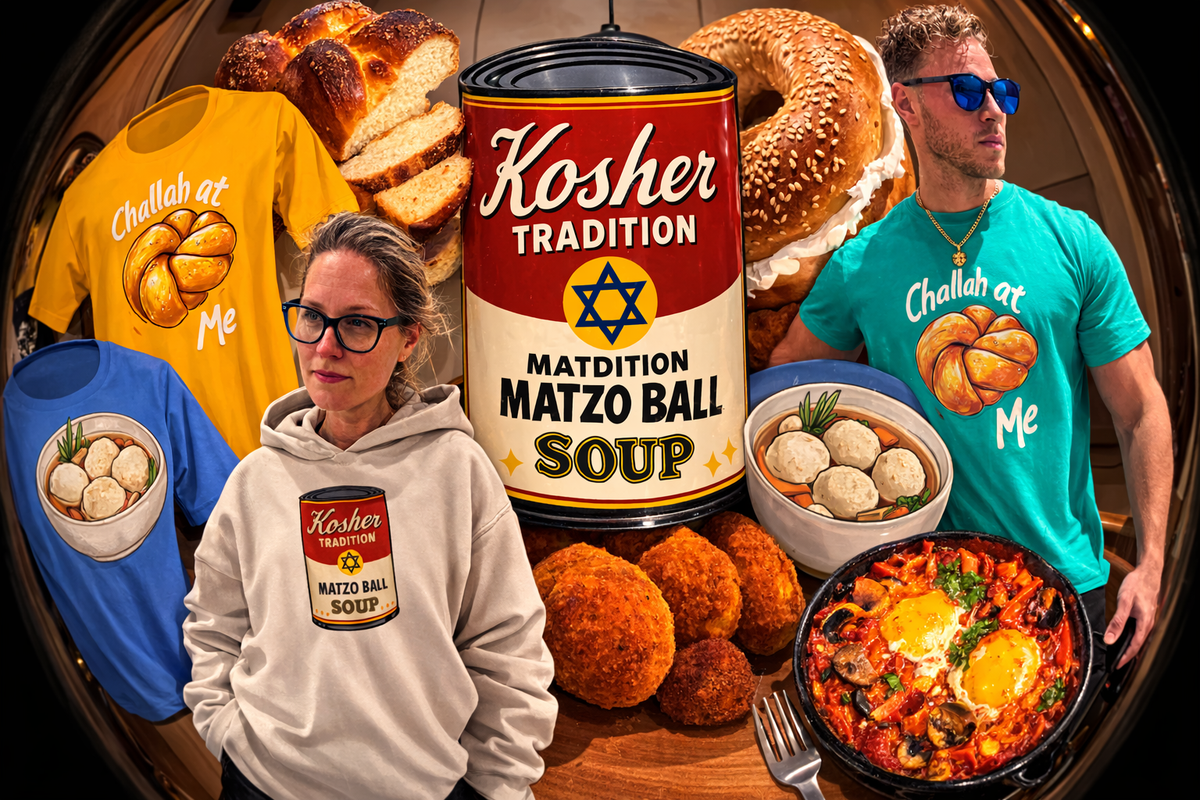
The richer dough symbolized celebration, abundance, and rest after a week of labor (Just like this T-Shirt symbolizes you're a lover of that Friday Challah feeling).
Not every Jewish community eats challah
While braided challah became iconic in Ashkenazi communities, Jewish communities around the world developed their own Shabbat breads.
- Ethiopian Jews traditionally eat dabo, a spiced round bread.
- Indian Jewish communities may serve coconut-based loaves or festive flatbreads.
- Mizrachi and Middle Eastern communities often serve pita, laffa, jachnun, or kubaneh.
Kubaneh, for example, is a slow-baked Yemenite Shabbat bread cooked overnight.
In other words, the bread may change from community to community, but the idea stays the same: Shabbat deserves the best bread you can make.
Is Falafel Israeli, Lebanese, Egyptian… or Something Else?

The most likely origin: Egypt
Many historians believe falafel originated in Egypt, where Coptic Christians created a fried bean patty called ta'amiya, made from fava beans.
Spread through the Middle East
- Egypt used fava beans
- Levant countries like Lebanon and Syria used chickpeas
- Israel adopted chickpea falafel as a popular street food
Jewish immigrants arriving in Israel embraced falafel quickly. It was cheap, vegetarian, and easy to eat on the go. Stuffed inside a pitta sandwich with tahini and salad? Yes, please!
Falafel is best understood as a regional dish with many cultural homes.
Which is honestly the most Middle Eastern answer possible.
Who Invented Matzo Ball Soup?

Somewhere along the timeline of Jewish history, someone looked at a piece of dry matzah and thought:
“What if this became a dumpling?”
The matzo ball likely evolved from Central European dumplings, particularly German knödel. Ashkenazi Jews adapted the recipe during Passover by replacing flour with ground matzah meal.
The result was a dumpling that could be eaten during the holiday while still feeling like comfort food. And honestly, it's been loved all year round since.
The real debate is texture.
- Floaters – light and fluffy
- Sinkers – dense and hearty
Families have been arguing about this for generations.
What Does “Shakshuka” Mean?

Shakshuka is the vibrant dish of eggs poached in a tomato and pepper sauce, served bubbling hot in a skillet. Yum! It really is, the Breakfast of Champions.
The name comes from Arabic and likely means “a mixture” or “all mixed together.”
Shakshuka likely originated in North Africa, particularly Tunisia, and spread through Jewish communities across the region.
Today it appears everywhere from street cafés to high-end restaurants.
Its ingredients are simple:
- Tomatoes
- Peppers
- Garlic
- Olive oil
- Eggs
- Spices like cumin or paprika
Proof that sometimes the best meals come from throwing good things into one pan.
Food, History, and Identity
Jewish food tells the story of a people who traveled widely but carried traditions with them.
Bagels came from Eastern Europe.
Falafel spread through the Middle East.
Shakshuka traveled from North Africa.
Matzo ball soup adapted from European dumplings.
Each dish reflects centuries of migration, creativity, and adaptation.
Which might explain why Jewish cuisine feels both ancient and constantly evolving.
And also why every Jewish grandmother insists her version is the correct one.