That Painted Seder Plate Is A Lie: About the Things We Put on Our Passover Table
That Painted Seder Plate Is A Lie
April 2026
About the Things We Put on Our Passover Table
The Con Hidden in Plain Sight
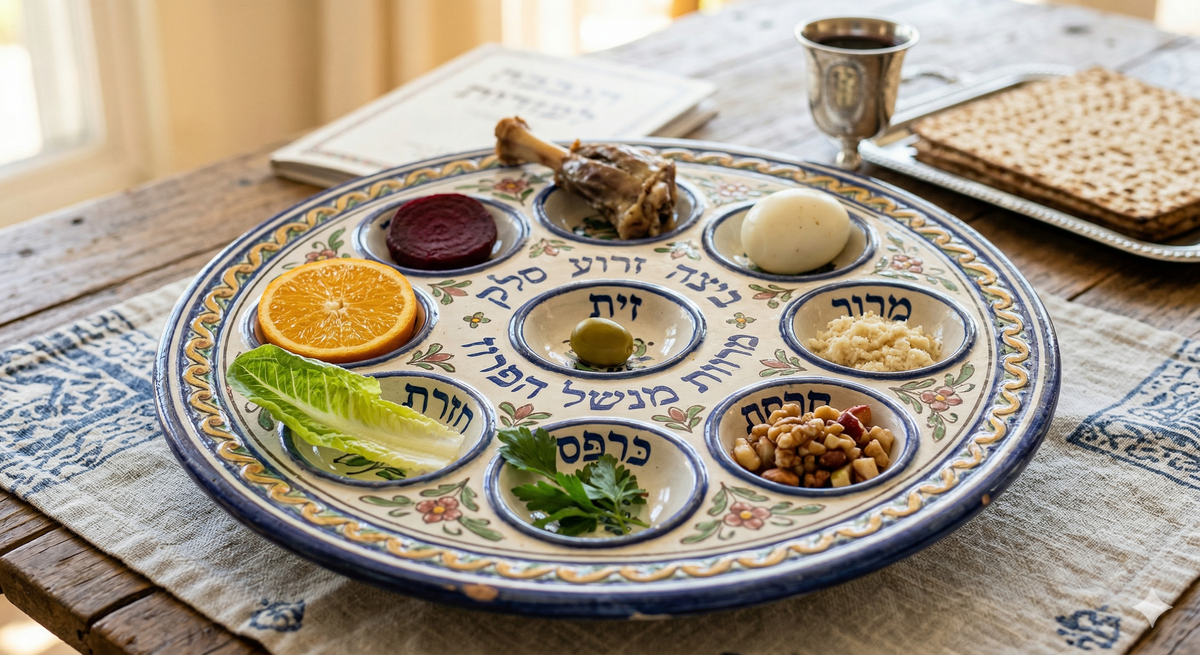
You know the plate. You've probably had the same one since childhood — ceramic, hand-painted, six labeled compartments arranged in a circle. Shankbone. Egg. Bitter herbs. Charoset. Karpas. Chazeret. Each one announced in Hebrew lettering, each one in its designated spot, each one so permanent-looking that the plate itself seems to be issuing a legal instruction.
Here is the thing nobody tells you: those labels were painted by a ceramicist, not handed down at Sinai.
The Seder plate as a unified, fixed, six-compartment object with a canonical set of items is a custom. A widespread, deeply beloved, aesthetically charming custom, but a custom nonetheless. The items on it represent a tradition that assembled itself over centuries of rabbinic discussion, regional variation, and community interpretation. There is no single authoritative halachic text that says: these six things, this plate, this configuration, forever. What the halacha actually says is considerably more interesting (and considerably more flexible) than the painted ceramic in your cabinet is letting on.
If you have been doing Passover your whole life and never once questioned what goes on the plate, you are not alone. You are also, it turns out, overdue for a conversation.
What Halacha Actually Says (It's Not What the Plate Says)
The actual non-negotiables of the Seder are narrower than most people assume. Tell the Exodus story. Eat matzah. Eat maror. Drink four cups of wine. Recline. That's the floor. Everything else, including every single item on your Seder plate, falls into the category of custom, symbol, and tradition. Profoundly meaningful custom, symbol, and tradition. But not a commandment.
The shankbone represents the Paschal sacrifice. The egg represents the festival offering. The charoset represents the mortar the Israelites used as slaves, which is Judaism's characteristic way of making even cement taste good. The karpas is a prompt for the first dipping, an appetizer engineered to make children ask questions. These are all real; they all mean something, and they've been on tables for a very long time. But "a very long time" is not the same as "always and unchangeably."
Persian Jewish families have used a roasted beet instead of a shankbone for centuries, based on a Talmudic ruling that permitted the substitution. Different communities arrange the plate differently. Sephardic and Ashkenazi traditions disagree on several points. Some communities have always included a seventh item. The Kabbalistic tradition, influenced by the Ari (Rabbi Isaac Luria) in 16th-century Safed, introduced an entirely different arrangement of the plate's items based on mystical reasoning that most painted plates have never heard of.[1]
The plate, in other words, has always been a negotiation. The ceramic just forgot to mention it.
What that means practically is this: there is room on your Seder plate for what your family, your community, and this specific moment in history need to remember. There always has been. You just needed someone to say it out loud.
Five Additions Worth a Spot at Your Table
The Orange
Placed on the Seder plate to represent the inclusion of historically marginalized groups within Jewish life, including LGBTQ+ Jews and women in leadership, the orange was introduced by scholar Susannah Heschel in 1984. The story you've probably heard, that someone told her there was as much room for a woman on the bimah as an orange on the Seder plate and she responded by putting one there, is a myth. Heschel has clarified this with visible exasperation. The actual origin is more intentional and less dramatic, which is perhaps why the myth is more popular.
Either way, the orange has earned its spot. It's been on tables long enough to have grandchildren. And as an orange has seeds, the symbolism holds: these communities carry the seeds of new life within the Jewish people. Plus it adds color to the plate, and ceramically speaking, the plate could use it.
The Olive
The olive branch is the oldest peace symbol in the Mediterranean world, and placing an olive on the Seder plate has become a practice for communities that want emphasize the desire for peace between Israelis and Palestinians. The Passover story is about an oppressed people demanding freedom. Some families find it meaningful to sit with that frame and ask who else is still waiting. It is not a comfortable addition. That's not a coincidence.
The Beetroot
If you're vegan or vegetarian and you've been staring at the shankbone slot on your plate for years feeling like a guest at your own holiday, this one's for you — and it comes with better historical credentials than you might expect. Using a roasted beet as a shankbone substitute has roots in Talmudic literature and has been practiced in some Sephardic and Middle Eastern communities for centuries. It's not a workaround. It's a legitimate alternative that the mainstream Ashkenazi tradition quietly sidelined and that is now, entirely appropriately, making a comeback.
Miriam's Cup
You know about Elijah's Cup, the wine poured for the prophet who visits every Seder simultaneously, which is either miraculous or a scheduling nightmare. Miriam's Cup is a newer addition: a cup of water placed on the table to honor Miriam the prophetess, who led the women of Israel in song after the crossing of the sea and who, per the Midrash, was responsible for the miraculous well that traveled with the Israelites through the desert. The Haggadah tells the Exodus story with a notable shortage of named women given how many of them kept the whole operation from collapsing. Miriam's Cup is the table's way of noting that fact. If you want to wear that acknowledgment as well as embody it, the Team Miriam Vintage Tee and the Team Miriam Hoodie make the position clear before you've even sat down.
The Empty Chair
An empty place setting at the Seder table was a tradition from 2024-2025 for the hostages held in Gaza, for those unable to celebrate freely, for communities that cannot be here, for those that we demanded "Bring Them Home".
Soviet Jews who couldn't emigrate. Communities decimated by the Shoah. Jews in places where a Seder had to be held in secret. The practice has deep roots and an obvious reason that felt urgent until recently. The Passover story is about people who could not leave. An empty chair is not a political statement. It is the Seder's own logic, applied to the present.
How to Run a Seder That Doesn't Feel Like a Staff Meeting
You've been to the Seder where someone reads every word of the Haggadah in a monotone while three people scroll their phones, two children have staged a quiet rebellion, and the brisket gets cold. You don't want to run that Seder. Here is how to not run that Seder.
Assign roles before anyone sits down. Nothing stops momentum like fifteen adults staring at the page waiting to see who goes next. Give people parts. The person who says they don't want a part wants a part.
Use the Four Children as a live discussion prompt. Which one are you this year? The answer changes. The conversation it starts is always better than the paragraph itself.
Let kids ask questions that aren't the Four Questions. The Mah Nishtanah is a prompt, not a ceiling. A Seder driven by genuine curiosity from an eight-year-old is functioning exactly as designed.
Make the afikomen negotiation happen before the meal. Everyone is more motivated before they're full. This is not a spiritual insight. It is logistics. If you want a tote bag that announces your intentions on arrival, the This Bag Is Definitely Not Hiding Matzah Afikomen Tote will do the work for you — and the No Sleep Till Afikomen Tote is for the parent who has lost this negotiation every single year and has simply accepted their fate.
Don't skip the closing. The Hallel, the final songs, L'shanah haba'ah b'Yerushalayim — these are the sections most likely to get quietly dropped when people are tired and have eaten too much charoset. They are also the theological point of the whole evening. A reasonable compromise: do the full closing declaration and one song. Chad Gadya is optional. Echad Mi Yodea is extremely optional. But if you've made it to the end of a full Seder, the only appropriate response is Dayenu — which is also available as a hoodie, for those who want to make that declaration from a position of extreme comfort.
Dress the table like it matters. It does. A Seder that looks good slows people down in the right way — they arrive, they look around, they feel the occasion. The Floral Pesach Apron is for the person who cooked everything and deserves visible recognition for it. The Floral Pesach Napkin Set and the Pesach Napkin Set are for the table itself. And if you're hosting and someone asks what they can bring, the Kosher for Passover Mug is the kind of gift that gets used on April 2nd and doesn't get quietly donated in May.
Frequently Asked Questions
Can I add things to the Seder plate?
Yes. Communities have been doing this for centuries. The additions don't replace the traditional items. They join them. The plate is a conversation, not a contract.
Is the painted plate wrong?
The painted plate is a wonderful object that has caused a completely understandable misunderstanding. It is not wrong. It is just more authoritative-looking than it has any right to be.
What if my family resists changes?
Lead with history, not politics. "Did you know Persian Jews have used a beet instead of a shankbone for centuries?" lands differently than "I've decided to make a statement." The former is a fun fact. The latter is a Seder argument. Both happen. Only one is useful.
Does adding an olive or an orange make it a political Seder?
Every item on the Seder plate is political if you follow the logic back far enough. The shankbone is a reference to a sacrifice. The maror is a reference to state-sanctioned slavery. The charoset is a reference to forced labor. The Seder has always been political. What changes is which politics feel visible.
What's the minimum viable Seder?
Tell the story. Eat matzah. Eat maror. Drink four cups. Recline. Everything beyond that is tradition — rich, meaningful, worth doing — but tradition. The floor is lower than the plate suggests.
What do I bring to a Seder I'm attending?
Wine is always correct. Something for the table — a Pesach Kitchen Hand Towel or the Pesach Napkin Set — is thoughtful without being presumptuous. A Kosher for Passover Mug for the host is the kind of thing that earns you a better seat next year. If there's going to be a baby at the Seder, the Pesach Matzo Ball Baby Bodysuit is the most correct gift in the known world. What you should probably not bring: chametz. You know who you are.
Is there appropriate Passover attire?
There is now. The Let My People Eat Tee covers the essential sentiment. The Moses & Aaron Original Brotherhood Tee is for those who appreciate the Exodus as a founding partnership. And the No More Matzah Tee is for day eight, when everyone at the table silently agrees but nobody says it out loud. Someone has to.
Why This Still Matters
The Haggadah says it plainly: b'chol dor v'dor — in every generation, each person is obligated to see themselves as if they personally left Egypt. Not to forget that their ancestors left Egypt. To feel it as if it happened to them.
That instruction only works if the Seder stays alive. A ritual that becomes rote stops asking anything of you. The Seder was designed specifically to prevent that — the questions, the children, the strange foods, the deliberate disorder of it all. But the painted plate has done some quiet damage. When the table looks like it has always looked, with the same six items in the same six compartments, it's easy to move through the motions without ever asking what the motions mean.
The orange, the olive, the beet, the cup of water, the empty chair — none of these are departures from the Seder. They are the Seder doing what the Seder was built to do: making the ancient feel urgent, making the table feel like it belongs to the people sitting at it, making sure that this year, when you ask why this night is different from all other nights, the answer isn't just "because it's Tuesday and we're out of horseradish."
Your Seder plate is not a museum artifact. It is a working document. Add to it accordingly.
L'shanah haba'ah b'Yerushalayim.
If you want to show up to your Seder dressed for the occasion — or send something to the host that communicates more than a bottle of Manischewitz ever could — the full Passover collection is right here. Some holidays deserve more than an afterthought.
Sources and Further Reading
- Yitzhak Luria (the Ari), as codified in Chayyim Vital, Pri Etz Chayyim, Sha'ar Chag HaMatzot. The Lurianic arrangement of the Seder plate, based on Kabbalistic sefirot, differs significantly from the standard Ashkenazi layout. ↩
- Susannah Heschel, The Schocken Book of Contemporary Jewish Fiction (New York: Schocken Books, 1992). See also Heschel's own account of the orange's origin in various interviews and essays published from the 1990s onward.
- Babylonian Talmud, Tractate Pesachim 114b–120b. The primary Talmudic source for Seder obligations and the items associated with the meal.
- Maimonides (Rambam), Mishneh Torah, Laws of Chametz and Matzah, chapters 7–8. The most systematic medieval codification of Seder requirements.
- Yosef Karo, Shulchan Aruch, Orach Chayyim 472–490. The authoritative Sephardic legal code on Passover observance, including Seder plate customs.
- Joseph Tabory, JPS Commentary on the Haggadah (Philadelphia: Jewish Publication Society, 2008). A thorough historical and textual analysis of how the Seder developed over time.